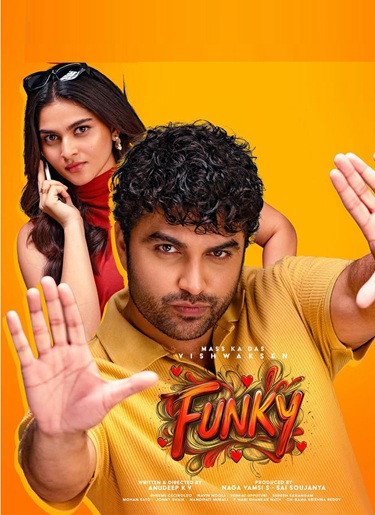
Funky
Fun Facts of Movie
Funky Movie: A Meta Telugu Comedy That Struggles to Stick the Landing

If you like movies about making movies, Funky (2026) probably caught your eye. It’s a Telugu comedy drama set inside the Telugu film industry, released on February 13, 2026, with Vishwak Sen and Kayadu Lohar leading the cast. On paper, the “film within a film” setup sounds like easy fun: set chaos, ego clashes, quick jokes, and a romance that grows while the camera is still rolling.
In practice, early reception has been mixed to negative. Some viewers are getting a few laughs, while many critics call the story thin and the pacing messy. This review keeps it simple and spoiler-free: what works, what doesn’t, and who might still enjoy it as a one-time watch.
What Funky is about, and why the film within a film idea matters
Funky centers on a young director who’s trying to finish his movie while everything around him threatens to fall apart. The hook is familiar but still appealing because it uses the film set as a pressure cooker. Money runs out, tempers rise, and everyone suddenly becomes an “expert” on how the film should be made.
That’s why the “film within a film” idea matters. When it’s done well, it can feel like peeking behind a curtain. You get jokes about vanity vans, last-minute script changes, awkward auditions, and the strange mix of glamour and chaos that comes with shooting a movie. Even if you’ve never stepped on a set, the workplace comedy part is easy to relate to. It’s the same energy as any deadline-driven job, just with brighter lights and louder egos.
Funky also tries to blend that behind-the-scenes humor with a straightforward romantic track. The romance is built around friction: one person wants creative freedom, the other wants control and accountability. That tension could have made the story tighter. Instead, the movie often plays like a string of skits that don’t always build toward something bigger.
Still, the premise gives the film a clear lane. The best moments come when the story stays focused on the simple question: Can this team finish the movie before the money and patience run out?
The story setup in plain English: Komal, Chitra, and a one crore deadline
Vishwak Sen plays Komal, an up-and-coming director making a film that’s already burning cash. The producer (played by Naresh) starts out backing the project, but the budget issues get out of hand. As the stress piles up, the producer pulls back and tries to shut the whole thing down before it drags his family into a financial mess.
That’s where Chitra (Kayadu Lohar), the producer’s daughter, steps in. She doesn’t just “support” from the sidelines. She takes charge of the remaining shoot and pushes Komal to wrap it up on a strict one crore budget. From there, the movie leans into set mayhem: quick fixes, awkward compromises, and constant scrambling to keep the production alive.
Meanwhile, Komal and Chitra’s relationship starts forming in the middle of that chaos. The romance is meant to grow out of proximity and pressure, the way workplace crushes sometimes do.
Does it feel fresh, or like a familiar comedy-drama formula?
The movie clearly wants meta-humor. It pokes at industry habits and uses the underdog-director angle to keep the stakes moving. At its best, that can feel playful and self-aware.
However, the overall shape can feel familiar. You’ve likely seen versions of this: the stubborn creator, the strict gatekeeper, a ticking financial clock, and comedic side characters adding noise to the mission. When the writing doesn’t sharpen those parts, the “inside film world” setting becomes more decoration than engine.
For a snapshot of how critics reacted to the movie’s satire and structure, see The Hindu’s review of Funky.
Performances and characters: who stands out, and who feels wasted
The cast is one reason people still try Funky, even with the mixed talk around it. Vishwak Sen brings his usual energy, and Kayadu Lohar has screen presence that reads well in a breezy, commercial setup. Naresh, playing the producer-father, gives the story its authority figure, the person who can end the dream with one decision.
The supporting cast also stacks the film with familiar faces. VTV Ganesh shows up with the kind of timing audiences expect from him. Sampath Raj appears in a track that should have raised the tension, but many viewers may feel it doesn’t connect cleanly to the main goal. Easwari Rao adds a steadier tone whenever the film briefly tries to ground the comedy with family emotion.
There are also cameo-style appearances from industry names, played for quick recognition and laughs. Those moments can be fun in theaters, especially for viewers who enjoy that “hey, I know them” jolt. The issue is that cameos don’t fix momentum. If the core scenes don’t build, familiar faces start to feel like extra seasoning on a dish that needed better cooking.
Where the film does score points is in small comic beats. A reaction shot here, a deadpan line there, a quick argument that feels oddly real. Those bits show what the movie could’ve been with tighter writing and cleaner scene goals.
Vishwak Sen as Komal: effort, comic timing, and where it falls short
Vishwak Sen commits to Komal’s stubbornness. He plays him like a guy who’s always thinking three steps ahead, even when the plan makes no sense. That approach can work for comedy because it creates contrast: everyone panics, he stays oddly calm.
At the same time, one common criticism is that the performance can feel forced in some stretches, especially when the movie pushes broad humor without giving the character a believable emotional base. When Komal’s motivations get fuzzy, the jokes lose their bite. It’s harder to root for a lead when the script doesn’t clearly show what he’s learning, or what he’s risking beyond his ego.
Kayadu Lohar as Chitra: charm factor and why the role needed more depth
Kayadu Lohar is often cited as a bright spot because she brings a clean, confident presence. Chitra also has a practical role in the story. She’s the one pushing the film toward completion, not just reacting to Komal’s antics.
Still, the part needed more depth. The script hints at competence and control, but it doesn’t always give her clear personal goals beyond “finish the movie” and “manage Komal.” Stronger scenes for Chitra could’ve added real weight: sharper conflict with her father, clearer boundaries with Komal, or even a moment where her choices cost her something.
When the writing gives her space, the character pops. When it doesn’t, she starts to feel like a tool to move Komal’s story forward.
Direction, writing, and craft: the real reason the movie clicks or crashes
Director K.V. Anudeep (who also co-wrote with Mohan Sato) goes for a loose, riff-heavy style. The film has an “improvised” feel in parts, like actors are encouraged to toss lines back and forth until something lands. That can be a strength in comedy because it keeps scenes alive.
The downside is control. Improvised dialogue needs a strong spine underneath it. Without that spine, scenes can run long, repeat the same idea, or end without payoff. Several reviews point to that exact problem: the movie often feels like bits stitched together instead of one clean story that keeps rising.
The film also nods at being inspired by industry-style situations. That’s a fun angle, but “inspired by” only matters if the movie turns those moments into sharp setups and satisfying punchlines. When it doesn’t, the inside jokes can feel like they’re for the crew, not the audience.
On the technical side, Bheems Ceciroleo’s music tries to keep things light. Navin Nooli’s editing, however, becomes a talking point because choppy transitions can make the film feel more scattered, especially later on. Suresh Sarangam’s cinematography keeps the look presentable, but visuals alone can’t create rhythm.
A comedy can survive a thin plot, but it can’t survive unclear scene goals. If a scene doesn’t move the story or land a laugh, it starts to feel long fast.
Comedy and pacing: when the chaos is fun, and when it drags
The comedy works best when it stays grounded in set problems: money panic, time crunch, petty power moves, and people trying to look important. Those situations create natural humor because the stakes feel real, even if the reactions are exaggerated.
Trouble starts when the movie repeats the same type of gag too often. A funny joke once becomes noise the third time. The pacing also suffers when scenes stretch without a clear turn, like the movie is waiting for a laugh instead of building one.
Even the romance gets caught in that rhythm issue. If the couple’s dynamic doesn’t evolve scene to scene, the relationship feels stuck in place. As a result, viewers who came for a sweet rom-com may feel the “rom” part stays undercooked.
Music, visuals, and editing: small wins that can’t fix big script gaps
The background score does help some comedy beats. In lighter stretches, the music keeps the tone from dropping. A few visual moments also sell the “set inside a set” vibe, which is important for a film like this.
Editing is where many viewers may notice strain. Comedy needs clean timing, especially in reaction shots and punchline pauses. When cuts feel abrupt, jokes can land flat. When scenes feel stitched, the movie’s emotional moments also lose impact because the audience doesn’t get time to settle.
In short, the craft has small wins, but the script’s gaps stay visible.
Final verdict: who should watch Funky (2026), and who should skip it
Funky is the kind of movie you put on when you want something light, and you don’t mind uneven storytelling. Since release, the critical mood has leaned mostly negative, with ratings like 2/5 and 1/5 appearing across reviews, even though a few outlets landed closer to the mid-range. Word-of-mouth also appears to have cooled quickly, and March 2026 trade tracking has pointed to a rough theatrical run compared with its reported budget.
A simple rating suggestion: 2 out of 5 as a one-time watch for the right crowd.
Here’s the clearest way to frame it:
- What works: A handful of jokes, some cameo fun, and Kayadu Lohar’s presence.
- What doesn’t: Thin story, uneven pacing, and humor that often repeats.
- Best part of the premise: The behind-the-scenes setup is still a good idea.
- Biggest miss: The movie doesn’t build to a consistent emotional or comic payoff.
Fans who enjoy film set comedy, or who mostly want to spend time with the leads, might still have a decent time. On the other hand, if you want tight writing, strong romance beats, or sharp satire that keeps escalating, it’s easy to see why many people are skipping it.
For another mainstream critic take that matches this “some jokes land, many don’t” vibe, check Times of India’s Funky review.
Conclusion
The key takeaway is simple: Funky (2026) has a likable setup and scattered laughs, but it struggles with story flow and payoff. If you’re a Vishwak Sen fan or you enjoy behind-the-scenes film jokes, it can work as a casual one-time watch. If you’re picky about pacing and romance writing, it’ll probably test your patience.
Have you watched Funky yet? Share what worked for you, a scene, a joke, or a performance, and keep it spoiler-free so others can decide.
Trending Movies:
Dangal Movie Review: Aamir Khan’s Inspiring Sports Biopic That Broke Box Office